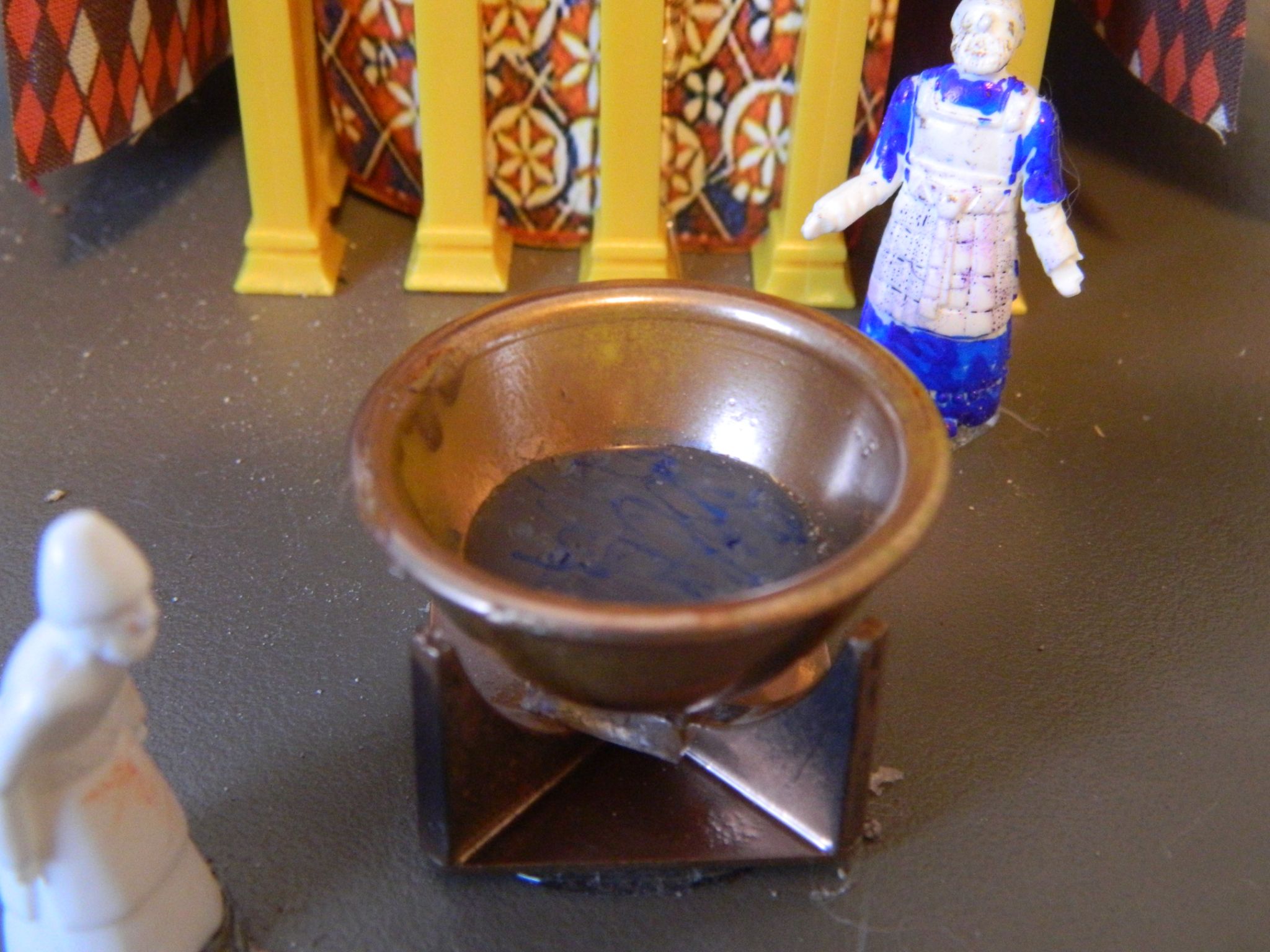
Bronze Laver
Define
- Kiyyor (כִּיּוֹר): The word "kiyyor" refers to a basin or laver, a wide, shallow vessel used for holding water. In the Tabernacle, it’s specifically the bronze container for ritual washing by the priests (Exod-30:18-21 Exod-30#v19 Exod-30#v20 Exod-30#v21). The Bible doesn’t define "kiyyor" explicitly, but its function is clear: it holds water for purification before entering the Tabernacle or offering sacrifices (Exodus 30:19-20, "for washing... so that they may not die"). Wash
- Bronze Nechoshet (נְחֹשֶׁת): This term denotes the material of the laver and its base, translated as "bronze" or "copper" in English. In the Bible, nechumet is used for various Tabernacle items (e.g., altar in Exod-27:2), indicating a durable, workable metal. The laver’s bronze came from mirrors (Exod-38:8), but no further etymological detail is provided.
- Ken (כֵּן): Refers to the stand or foundation of the laver, also made of bronze. The Bible doesn’t describe its shape or construction but indicates it supports the laver (Exod-30:18). The term "ken" implies a pedestal or footing to hold the basin steady for use.
- Rachats (רָחַץ): This verb describes the laver’s purpose: the priests washed their hands and feet to cleanse themselves ritually (Exodus 30:19, "Aaron and his sons shall wash"). The action is tied to purification to avoid death when approaching God’s presence (Exodus 30:20-21).
Related words
Additional Info
The Laver
God gave the Bronze Laver in the Tabernacle to wash clean their hands and feet.
- This washing was not merely physical but symbolized spiritual cleansing, as the priests needed to be pure to approach God’s presence.
- Being in right relationship and Clean //righteous //, they were now prepared to enter into the Holy Place Set Apart Place.
- Righteousness is described as a state of being “clean” before God, free from sin’s defilement, which the laver facilitated in the priestly service. - There was a veil Veil between the Outer Courts and the Holy Place, only a Priest could pass through into the Holy Place.
- The bronze laver was made from the mirrors of the women serving at the entrance to the Tent of Meeting (Exod-38:8). Mirrors in ancient times were associated with vanity, and their transformation into a tool for purification suggests a shift from self-focus to God-focused righteousness
Ancient manuscripts and archaeological evidence show that Egyptian, Mesopotamian, Canaanite , and Hittite religions used water purification in rituals, often with basins or vessels, similar to the bronze laver’s function. However, the laver’s precise placement between the altar of burnt offering Bronze Altar and the Tent of Meeting is unique compared to these setups. No non-biblical text or artifact describes a basin fixed in this transitional position within a linear, portable sanctuary like the Tabernacle.
Feast of Unleavened Bread
God commands Israel to eat unleavened bread for seven days, from the 14th //Fourteen// to the 21st //Twenty-one// day of the first //One// month (Nisan), removing Leaven from their homes to commemorate their hasty exodus from Egypt (Exod-12:39). The feast is reiterated in Exod-13:6-7, emphasizing no leaven is to be seen among the Israelites.
Deut-16:1-8Deut-16#v2Deut-16#v3Deut-16#v4Deut-16#v5Deut-16#v6Deut-16#v7Deut-16#v8 connects the feast to the Passover sacrifice, eaten with Unleavened Bread, called the “bread of affliction.” The feast symbolizes deliverance, purity (leaven often represents sin or corruption), and separation from Egypt.
Both the laver and the feast involve purification, though in different ways. The laver ensures physical and ritual cleanliness for priests (Exod-30:18-21Exod-30#v19Exod-30#v20-21), symbolizing holiness before God. The Feast of Unleavened Bread involves removing leaven, often interpreted as a symbol of sin or corruption. Exod-12:15 mandates removing leaven, suggesting a communal purification to honor God’s deliverance. While both emphasize purity, the laver’s role is priestly and ritual, while the feast’s is communal and symbolic, tied to the exodus event.
However, the Bible, does not make a direct connection between the bronze laver and the Feast of Unleavened Bread.
God provided a way.
Before Gate of Wisdom/Beings/Jesus one came preparing a way, he was called John the Baptizer.
John called people to an immersion in the river as a baptism of repentance from sin, marking a turning away from Lawlessness (Sin). This is referred to as John's Baptism.
At the Passover Meal, Jesus, as the Bread of Life, offered the unleavened bread as his body, in memory of himself.
The bread representing dying to lawlessness (sin). Jesus was buried on the Feast of Unleavened Bread.
They had always eaten the unleavened bread at the Passover Meal, but Jesus changed why, he said to eat it at the Passover Meal in remembrance of him.
At his death, the veil between the Outer Courts and the Holy Place was torn from top to bottom, into two pieces, he had prepared the way for whoever into the Holy Place.
God provided those who eat of the Bread of Life (Jesus), a way to live forever, free from leaven (sin).
He sacrificed his fleshly body and died to sin, once and for all. Those trusting (faith) and obeying him, have also crucified their body and are no longer captive to lawlessness (sin).
Related Scriptures
Zech-13:1 “In that day there is a fountain opened || To the house of David || And to the inhabitants of Jerusalem, || For sin and for impurity.
some scholars believing they were fulfilled in the Maccabean period (2nd century BC), while others see them as still awaiting future fulfillment
John-06:51 I am the living bread, which came down from heaven. If anyone eats this bread, he will live forever. This bread is My flesh, which I will give for the life of the world.”
Rom-06:19, Hebrews 1:9: what participation is there between righteousness and lawlessness // loved righteousness and hated lawlessness
Ps-24:3-4 Who goes up into the hill of YHWH? And who rises up in His holy place? The clean of hands, and pure of heart, || Who has not lifted up his soul to vanity, || Nor has sworn to deceit.
Exod-30, Lev-08, John-13 sound similar
Exod-30:18Exod-30#v19Exod-30#v20-21 18 “Make a bronze basin for washing and a bronze stand for it. Set it between the tent of meeting and the altar, and put water in it. 19 Aaron and his sons must wash their hands and feet from the basin. ... 21 They are to wash their hands and their feet, so that they do not die. It is to be an eternal statute for them, to him and to his offspring throughout their generations.”
Lev-08:6 6 Then Moses presented Aaron and his sons and washed them with water.
John-13:5-14John-13#v6John-13#v7John-13#v8John-13#v9John-13#v10John-13#v11John-13#v12John-13#v13John-13#v14 5 Next, he poured water into a basin and began to wash his disciples’ feet and to dry them with the towel tied around him. ... 10 “One who has bathed,” Jesus told him, “doesn’t need to wash anything except his feet, but he is completely clean. You are clean, but not all of you.” ... 8 ... Jesus replied, “If I don’t wash you, you have no part with me.” ... 11 For he knew who would betray him. This is why he said, “Not all of you are clean.” ... 14 So if I, your Master and Teacher, have washed your feet, you also ought to wash each other’s feet.
Ps-58:10 The righteous one will rejoice when he sees the retribution; he will wash his feet in the blood of the wicked.